How to turn a shipping container into a hunting camp gear room in Mississippi
Set a 40ft high cube on gravel where the truck can reach, bolt a lock box over the door handles, hang solar lights and no-drill shelving, cut one opening for a solar vent, and put up a hook wall for bows, packs and coveralls. That gives you a locked, dry, lit room at camp that holds a four-wheeler, feeders and a season of gear, and goes with you when the lease changes.
Why camps end up with a container
A camp is empty for weeks at a time, and that is when things walk off. A wood shed gets pried open, chewed by mice and soaked through a bad roof. A container locks like a vault, keeps the rodents and weather out, and sits on gravel instead of a slab you would have to pour on someone else's land.
A 40ft high cube is the camp size: about 300 square feet of floor with 9'6" outside height, so there is room for a four-wheeler down one side, feeders and corn at the back, a freezer for generator days, and a wall of gear. When the lease changes hands, it leaves on a tilt-bed with you.
What goes in, and why each piece
A puck lock box bolted over the door handles is the one part that matters most; it shields the padlock from bolt cutters on a camp nobody is watching. Solar string lights charge off the roof, so you can find things at 4 a.m. with no wiring. Shelving brackets hang on the corrugation without drilling. Magnetic hooks put bows, packs and lanterns off the floor.
The one cut is for a solar-powered vent on the end wall. A sealed box sweats between trips, and that is how feed sacks and boots mildew. The plan set draws where the vent goes and where the hook wall and shelving land. If you want a man door or a window, those are weld-in kits we quote with the container.
The road in is the real test
Camp roads are the usual problem, not the camp. A tilt-bed carrying a 40ft needs about 100 feet of straight run, 14 feet of clear sky and firm ground where the box comes off. Sandy two-tracks, low-water crossings and gated timber roads all matter; tell us before you order, because a truck that cannot get in is a billable trip.
If the club shares one box, the lease gear room splits it into numbered bays with two locks. For securing it once it is there, see jobsite container security; the same rules apply in the woods.
Who gets a key
Count the keys and know who has them. For a family camp, one padlock in the lock box is enough. For a club, two padlocks on the door bars means two people hold access and a lost key costs one lock, not a new one for everyone; see the best lock for a container.
The layout, drawn to the box
This is sheet 2 of the free Hunting Camp Box plan set: the 40ft high cube container drawn from real ISO dimensions, with every shelf, rack and opening placed. A four-wheeler bay inside the doors, feed on pallets, a hook wall for bows and packs, an 8 ft shelf run, a solar vent. One cut (the vent).
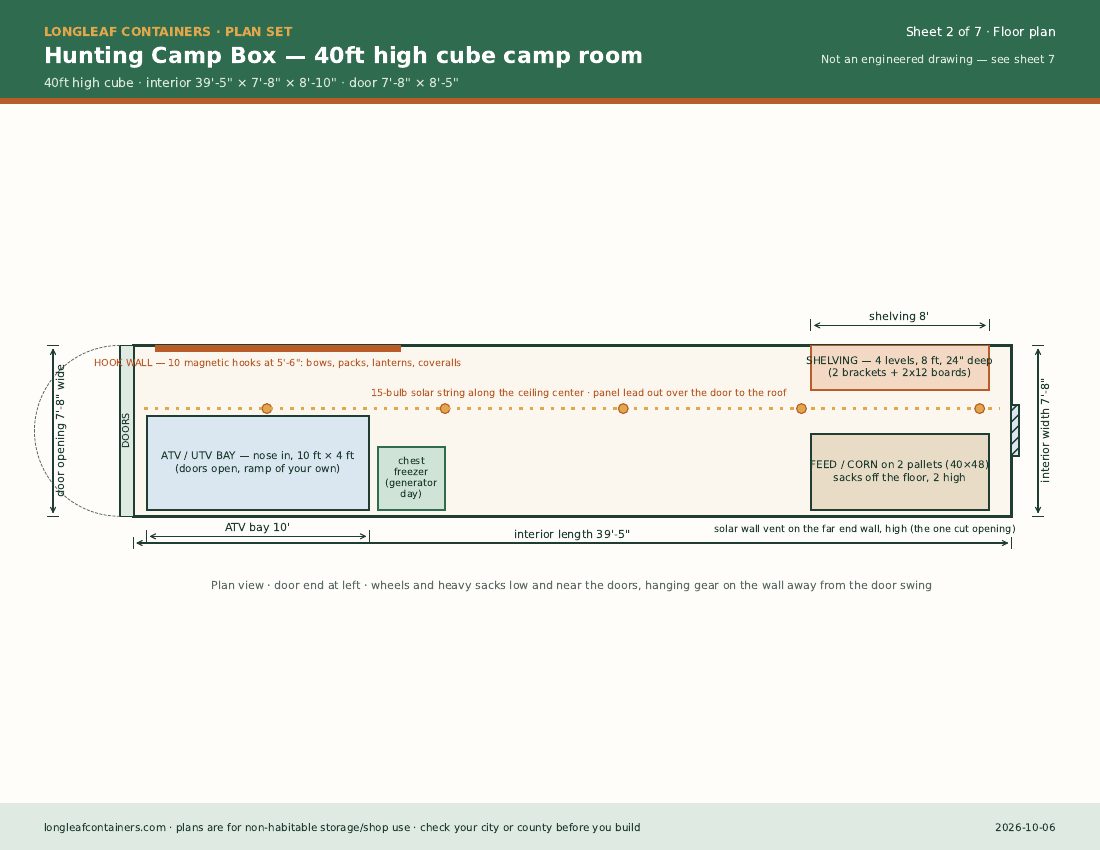
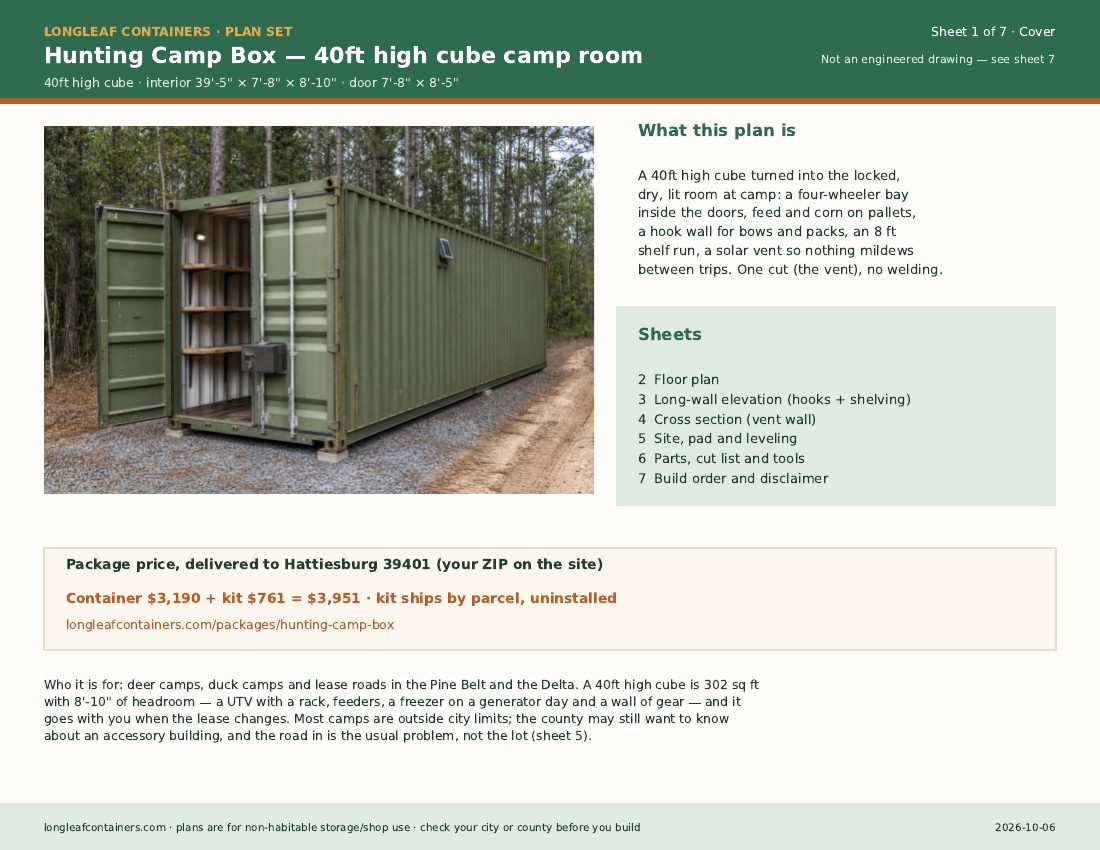
All seven sheets: Cover and package price · Floor plan · Long-wall elevation: hook wall and shelving · Cross section: vent wall · Site, pad and leveling · Parts, cut list and tools · Build order and disclaimer. You buy locally: four 2x12s, two pallets, corner blocks, a ramp pair — roughly $150–$230.
See the Hunting Camp Box package — container and kit, delivered price by ZIP →
Buying a container?
Longleaf sells used and one-trip 20ft and 40ft shipping containers, delivered by tilt-bed across the Pine Belt. Enter your ZIP for the delivered price — it comes straight from the supplier feed and already includes the haul. Locks, vents, shelving and lights are on the accessories page. We sell; we do not rent.
Keep reading
- A shipping container workshop in the Pine Belt: lights, shelving, power and the door question — How to set up a 40ft shipping container as a workshop in the Pine Belt: solar lights, no-drill shelving, one cord in for power, leveling, and the door choice.
- What can you build with a shipping container? Thirteen projects people actually set up, with a free plan for each — Thirteen things people build from a shipping container, from workshops and deer-camp gear rooms to feed rooms and garages, each with a free plan and parts list.
- Using a shipping container as a feed room on a Mississippi cattle or poultry farm — How to set up a 20ft shipping container as a farm feed room in Mississippi: two vents, shelving, leveling on pasture, and keeping feed, minerals and meds dry.
- A container tack room for a Lamar County barn: saddle racks, vents and the layout — How to set up a 20ft shipping container as a tack room in south Mississippi: saddle racks from 2x6s, two vents against mildew, shelving, and where to set it.
- Getting a zero-turn into a shipping container: door width, ramp length and deck size — Will a zero-turn mower fit in a shipping container? Door width, deck sizes that clear, ramp length, and how to set up a 20ft for mowers and a landscape crew.
Across the Pine Belt
Hattiesburg · Petal · Laurel · Ellisville · Purvis · Sumrall · Columbia · Collins · Seminary · Wiggins